
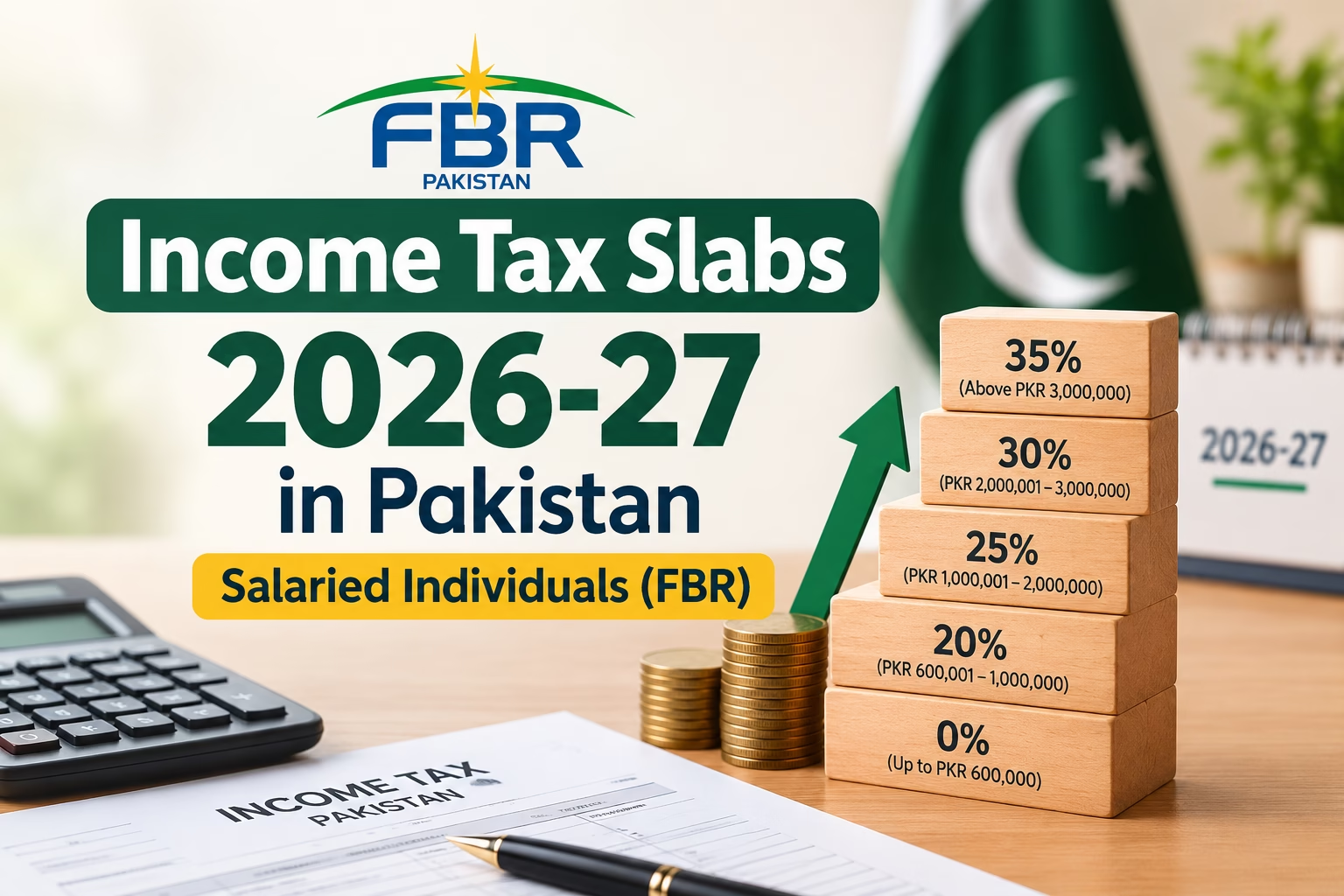
Income Tax Slabs 2026-27 in Pakistan — Salaried Individuals (FBR)
Pakistan’s income tax slabs for salaried individuals changed on 1 July 2026 under the Finance Act 2026. If you are still using the 2025-26 rates, your tax estimate will be wrong — in most middle-income cases, the new slabs mean you pay less tax than last year.
Quick answer: Salary up to Rs 600,000 per year (Rs 50,000 per month) is completely tax-free. Above that, progressive rates of 1%, 11%, 20%, 25%, 29% and 32% apply, and the top rate of 35% now starts above Rs 7,000,000 instead of Rs 4,100,000. The 9% surcharge on high salaries has been abolished.
Calculate your exact tax now: Use our free Salary Tax Calculator Pakistan 2026-27 — enter your monthly salary and see your monthly tax, annual tax and take-home pay instantly.
Income Tax Slabs 2026-27 for Salaried Individuals
| Annual Taxable Salary | Tax Rate |
|---|---|
| Up to Rs 600,000 | 0% |
| Rs 600,001 – Rs 1,200,000 | 1% of the amount exceeding Rs 600,000 |
| Rs 1,200,001 – Rs 2,200,000 | Rs 6,000 + 11% of the amount exceeding Rs 1,200,000 |
| Rs 2,200,001 – Rs 3,200,000 | Rs 116,000 + 20% of the amount exceeding Rs 2,200,000 |
| Rs 3,200,001 – Rs 4,100,000 | Rs 316,000 + 25% of the amount exceeding Rs 3,200,000 |
| Rs 4,100,001 – Rs 5,600,000 | Rs 541,000 + 29% of the amount exceeding Rs 4,100,000 |
| Rs 5,600,001 – Rs 7,000,000 | Rs 976,000 + 32% of the amount exceeding Rs 5,600,000 |
| Above Rs 7,000,000 | Rs 1,424,000 + 35% of the amount exceeding Rs 7,000,000 |
Source: Finance Act 2026, First Schedule, Income Tax Ordinance 2001 (FBR). These slabs apply to Tax Year 2027 (1 July 2026 to 30 June 2027).
An individual counts as “salaried” when salary income is more than 75% of their total taxable income.
What Changed from 2025-26?
| Annual Salary Band | 2025-26 Rate | 2026-27 Rate |
|---|---|---|
| Up to Rs 600,000 | 0% | 0% (no change) |
| Rs 600,001 – 1,200,000 | 1% | 1% (no change) |
| Rs 1,200,001 – 2,200,000 | Rs 6,000 + 11% | Rs 6,000 + 11% (no change) |
| Rs 2,200,001 – 3,200,000 | Rs 116,000 + 23% | Rs 116,000 + 20% |
| Rs 3,200,001 – 4,100,000 | Rs 346,000 + 30% | Rs 316,000 + 25% |
| Rs 4,100,001 – 5,600,000 | Rs 616,000 + 35% | Rs 541,000 + 29% |
| Rs 5,600,001 – 7,000,000 | 35% | Rs 976,000 + 32% |
| Above Rs 7,000,000 | 35% | Rs 1,424,000 + 35% |
| Surcharge above Rs 10M | 9% of tax payable | Abolished |
In simple words: salaries below Rs 183,333 per month pay the same tax as last year. The relief starts above that level, and it grows with income.
Tax on Common Salaries in 2026-27
| Monthly Salary | Annual Salary | Annual Tax | Monthly Tax | Monthly Take-Home |
|---|---|---|---|---|
| Rs 50,000 | Rs 600,000 | Rs 0 | Rs 0 | Rs 50,000 |
| Rs 75,000 | Rs 900,000 | Rs 3,000 | Rs 250 | Rs 74,750 |
| Rs 100,000 | Rs 1,200,000 | Rs 6,000 | Rs 500 | Rs 99,500 |
| Rs 150,000 | Rs 1,800,000 | Rs 72,000 | Rs 6,000 | Rs 144,000 |
| Rs 200,000 | Rs 2,400,000 | Rs 156,000 | Rs 13,000 | Rs 187,000 |
| Rs 250,000 | Rs 3,000,000 | Rs 276,000 | Rs 23,000 | Rs 227,000 |
| Rs 300,000 | Rs 3,600,000 | Rs 416,000 | Rs 34,667 | Rs 265,333 |
| Rs 500,000 | Rs 6,000,000 | Rs 1,104,000 | Rs 92,000 | Rs 408,000 |
| Rs 1,000,000 | Rs 12,000,000 | Rs 3,174,000 | Rs 264,500 | Rs 735,500 |
Worked Example: Tax on Rs 200,000 Monthly Salary
Annual salary = Rs 200,000 × 12 = Rs 2,400,000
This falls in the slab Rs 2,200,001 – Rs 3,200,000.
- Fixed tax for the slab: Rs 116,000
- Amount above Rs 2,200,000: Rs 200,000
- 20% of Rs 200,000: Rs 40,000
- Annual tax: Rs 116,000 + Rs 40,000 = Rs 156,000
- Monthly tax: Rs 156,000 ÷ 12 = Rs 13,000
- Monthly take-home: Rs 187,000
Note that the 20% rate applies only to the amount above Rs 2,200,000 — not to your whole salary. Your effective tax rate here is only 6.5%, even though your slab rate is 20%.
How to Calculate Your Salary Tax in 4 Steps
- Multiply your monthly gross salary by 12 to get your annual salary.
- Find your annual salary in the slab table above.
- Apply that slab’s formula: fixed tax + rate × amount above the slab’s lower limit.
- Divide the annual tax by 12 for your monthly deduction — this is what your employer withholds under Section 149 of the Income Tax Ordinance.
Or skip the maths: enter your salary in our free salary tax calculator and get the result instantly.
FAQs
What is the tax-free salary limit in Pakistan for 2026-27?
Annual salary up to Rs 600,000 (Rs 50,000 per month) is completely tax-free for salaried individuals.
How much tax is deducted on a Rs 100,000 monthly salary?
Rs 100,000 per month is Rs 1,200,000 per year. Tax = 1% of the amount above Rs 600,000 = Rs 6,000 per year, i.e. only Rs 500 per month. Your take-home is Rs 99,500.
How much tax is on a Rs 300,000 monthly salary in 2026-27?
Rs 300,000 per month is Rs 3,600,000 per year. Tax = Rs 316,000 + 25% of Rs 400,000 = Rs 416,000 per year, or about Rs 34,667 per month. Last year the same salary cost Rs 466,000 — you save Rs 50,000 this year.
If my salary crosses into a higher slab, is my whole salary taxed at the higher rate?
No. Pakistan uses progressive slabs. Each rate applies only to the income inside that slab. A salary increase can never reduce your take-home pay.
Is there still a surcharge on high salaries in 2026-27?
No. The 9% surcharge that applied to salaried individuals with taxable income above Rs 10 million has been abolished under the Finance Act 2026.
From when do the 2026-27 slabs apply?
From 1 July 2026 to 30 June 2027 (Tax Year 2027) — including the salary tax your employer deducts every month.
Are the slabs the same for government and private employees?
Yes. The same FBR salaried slabs apply to both government and private sector employees.
Why is my employer deducting more tax than the calculator shows?
Your employer estimates your full-year income in advance, including bonuses, arrears or mid-year increments, and divides the expected annual tax by 12. A bonus or raise during the year increases the remaining monthly deductions. Any extra amount is adjusted when you file your return.
Last updated: Rates are based on the Finance Act 2026 published by the Federal Board of Revenue (FBR). This article is for information and estimation only and is not a substitute for professional tax advice or an FBR assessment.
