
Filer and Non-Filer in Pakistan, Benefits, and Tax Details
In Pakistan, the distinction between filer and non-filer goes beyond mere paperwork; it affects your ability to access loans, government contracts, and even travel opportunities. We’ll explore what it means to be a filer or a non-filer, the benefits associated with each status, and key tax details that every citizen should know, helping you make informed financial decisions.
What is a Filer and a Non-Filer
A filer is a person or organisation that is present on the Active Taxpayers List and registered with the Federal Board of Revenue (FBR). The FBR has knowledge of its assets, income, transactions, and taxes. They pay their taxes regularly, and as a result, they enjoy more financial and legal benefits in comparison to a non-filer. Filer persons include salaried individuals earning above 60k, business owners, freelancers, property and vehicle owners, investors, shareholders, and Foreign Remittance Receivers.
A non-filer is a person or a business not registered with FBR or present on the list of Active Tax Payers. These people may be lacking in the threshold amount required. For filing, or intentionally or unintentionally avoiding tax. They are bound to pay higher tax rates and face difficulty in accessing other benefits that filers enjoy.

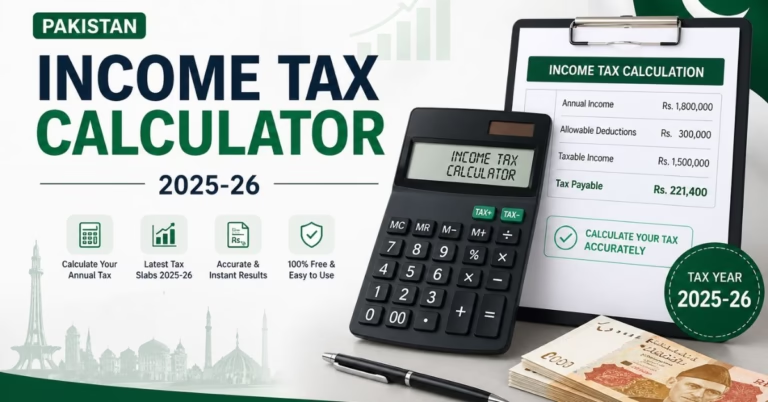
What is a Filer Tax Calculator
It is a tool that calculates the dues amount based on income and status, giving an idea of how much a person needs to pay in responsibility. These calculators are designed according to rules and provide results based on user input.

How to Calculate Tax
It is calculated based on income. To calculate:
- Enter income details
- Apply the toll slab
- Adjust deductions if applicable
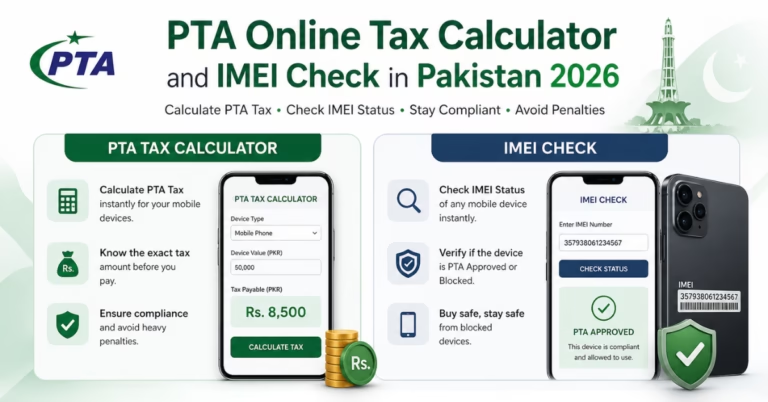
The final amount shows the liability. It is to be noted that the actual tax may differ depending on updated laws or additional factors. You can also check PTA Tax Calculator.
Why Use our Online Calculator?
It gives results with changing liabilities. It also helps understand how submitter status affects tolls. Your data remains confidential as we respect your privacy and security. We ensure that our tool is consistently current.
Key Differences Between Filers And Non-Filers
| Features | Filer | Non-Filer |
|---|---|---|
| Tax Rate | Lower tax rates | Higher tax rates |
| Withholding Tax on Bank Transactions | Reduced withholding tax | Higher withholding tax deduction |
| Property & Vehicle Registration | Lower taxes and easier registration | Higher taxes and additional restrictions |
| Loan & Credit Card Eligibility | Higher approval chances | Lower approval chances |
| Active Taxpayers List (ATL) | Included | Not Included |
| Government Contracts & Benefits | Eligible | Generally not eligible |
| Risk of Penalties | Lower risk | Higher risk of notices, penalties and audits |
| Tax Refunds | Eligible | Generally not eligible |
| Tax Credit on Donations | Available | Not Available |
| Property Purchase Restrictions | No additional restrictions | Subject to tax-related restrictions |
| International Travel | Easier financial documentation | May require additional financial verification |
Who is a Tax Filer? Are You a Tax Filer?
Anyone who earns 60,000 per annum is eligible to file. If you are 18 or above and earning 60k per annum, it makes you eligible for a filer, whether you are a Pakistani or an international citizen.

How to Become a Filer?
Becoming a filer is not as difficult as many people assume. There are two methods to become a filer: the physical method and the online method. The physical method requires going to the tax office, fill Nation Tax Number (NTN) form provided by FBR. You would need documents like an Identity Card, an Employer certificate if you are an employee, a bank statement, and a domicile.
With the improvement in working methods of FBR, they now have an online method, which is much easier than the physical one. All the process is explained in the following.
How to Get NTN
Go to the FBR IRS portal or click on https://iris.fbr.gov.pk/, go for registration for unregistered, fill the form, and FBR provides the NTN, which is your CNIC number. Verify NTN, enter the required details, and submit the form. After that, you have to pay a fee for registration. After this process, you will receive a login or password for the IRIS portal.
Log in to FBR’s IRIS System
Visit the FBR IRIS portal or click on https.//iris.fbr.gov.pk, you would be asked for a CNIC number or password. Enter your CNIC number or the password received during the registration process. Complete your profile. If you want to change any details, you can, and after that, attach all the required documents.
File Your Income Tax Return
You need to provide documents for verification of your income, like property details, electricity bills, bank statements, etc., and you will be provided with the latest tax year.
For a complete guide: go to the IRIS portal, click on declaration> income tax return> fill section> submit. Filer status will be confirmed within 24 hours or after the update, and you will be entered on the active taxpayers list (ATP). Check at https.//www.fbr.gov.pk/?aspxerrorpath=/atl for filer status confirmation, and after confirmation, pay previous tax returns to stay active on ATP.
Benefits of Becoming a Tax Filer in Pakistan
As loyal citizens, it is everyone’s duty to become filers to contribute to their country’s economy. It’s a legal obligation to become a filer if eligible, with the primary reason that filers facilitate more than non-filers, from property taxes to vehicles, they pay less in taxes than non-filers.
Lower Tax Deductions On Banking Transactions
If filers’ transactions exceed the daily limit of 50,000, they are obliged to pay only 0.3% tax on their amount; in comparison, non-filers pay double, about 0.6%, and the tax is deducted from their account within the period of their transaction under FBR rules.
Reduced Tax On Property Transactions
When a filer buys or purchases a property or a real estate, they get less CGT, whereas non-filers get a hefty penalty both on buying and selling. They are secured with a holding tax and can buy property worth above PKR 5 million. No restriction on the use of declared assets in the tax list, but non-filers pay a penalty on everything that is undeclared.
Lower Vehicle Registration & Token Tax
Filers save thousands annually through lower token tax, buying, transfer of ownership, or selling a vehicle or property, and non-filers cannot enjoy such luxury and are not allowed to buy high-value assets or vehicles, and if they do, they are made to pay high taxes.
Easier Access To Bank Loans & Credit Facilities
Being a filer means being a trusted person, and a non-filer means no guarantee for the financial situation. That’s why filers find it easier to get loans, visa approval, and many things like car financing. Non-filers become deprived of foreign remittances, international investments, a travel visa, and, in some cases, their passports can be banned. Freelancers and expats have to give tax filing proof; otherwise, they may suffer from account freezing.
Protection From FBR Notices, Audits & Penalties
Filers are protected from random audits and penalties if taxes are delayed, and they are not suddenly subjected to legal action. They are taken under investigation only when the period for tax payment becomes excessively long. Non-filers can be subjected to bank account inspection, their account or property may freeze, and FBR can investigate them without any notice.
Eligibility For Government Subsidies & Incentives
Being a filer in Pakistan comes with many opportunities, from subsidies for small businesses to loan packages. They can get help through financial and economic programs and housing schemes, and non-filers remain deprived of these opportunities, and if they get such opportunities, the process becomes long and difficult.
Stronger Financial Profile & Credibility
When a person files a filer status, he/she are not only a responsible citizen but also getting them some good opportunities for the future. They have a documented history of their finances, which makes them thrive in business, international corporate, and high-value investments. Clients and companies trust verified persons because they are reliable for financial security.
Lower Tax Rates On Investments & Dividends
If a filer invests in real estate, the stock market, or mutual funds, they have reduced tax on investments, and their chances of achieving better results increase. They pay lower taxes on each fund or stock they buy.
Future-Proofing Against Stricter Tax Laws
A filer’s future is safe with paying taxes; in 2026, the FBR government has become more advanced. Now, there is complete tracking of money, automated deductions, and an eye on bank transactions. It is every good citizen’s duty to pay taxes and remain safe from such tracking and investigations.
Consequences for Non-Filers
Non-filers are limited to less property, more taxes, according to section 114B of the ITO 2001 in finance act in 2022. FBR can hold non-filers ’ electricity, gas, and travel if taxes are not paid. Becoming a filer reduces such results.
Restrictions on Financial Transactions
Non-filers are not allowed to buy high-value assets, property, or vehicles exceeding their transaction limit. During online transactions, they can transact an amount of 50,000 – 20,0000. They will be charged taxes as the amount of their transactions increases.
Visa and Travel Restrictions
They cannot travel to non-religious countries or move internationally without paying their taxes, as international or tier-1 countries prefer financial stability and a source of trust in the traveler. When traveling to muslim countries, filers pay 15,000 tax on travel, while non-filers pay double, which is 30,000, to pressurize them.
Penalties and Audits
They can become targets of sudden investigation, hefty penalties, and random audits, making their daily life difficult.
Higher Withholding Taxes
Whether an employer, a business company, or a freelancer, the government has now issued 15% to 20% taxes on their gross income. Non-filers can get a 100% penalty in some cases, or their property can be seized under certain circumstances, while filers pay less taxes.
SIM Card Blocking
If they are crossing restrictions like buying assets or vehicles that exceed the limit, then the FBR has the right to block their mobile SIM, which will force them to pay their due taxes.
Income Tax Rates for Filer and Non-Filer
FBR has designed different tax slabs for Filer and non-Filer, where Filer has to pay less taxes and the has to pay a lot, not only taxation but also With Holding Taxes(WTH). The government has divided taxes for salaried and non-salaried individuals so let’s discuss them on by one.
Salaried Individuals
| S.No | Taxable Income (PKR) | Rate of Tax |
|---|---|---|
| 1 | Up to 600,000 | 0% |
| 2 | 600,001 – 1,200,000 | 5% of the amount exceeding Rs. 600,000 |
| 3 | 1,200,001 – 2,200,000 | Rs. 30,000 + 15% of the amount exceeding Rs. 1,200,000 |
| 4 | 2,200,001 – 3,200,000 | Rs. 180,000 + 25% of the amount exceeding Rs. 2,200,000 |
| 5 | 3,200,001 – 4,100,000 | Rs. 430,000 + 30% of the amount exceeding Rs. 3,200,000 |
| 6 | Over 4,100,000 | Rs. 700,000 + 35% of the amount exceeding Rs. 4,100,000 |
Non-Salaried Individuals & Association of Persons (AOPs)
| S.No | Taxable Income (PKR) | Rate of Tax |
|---|---|---|
| 1 | Up to 600,000 | 0% |
| 2 | 600,001 – 1,200,000 | 15% of the amount exceeding Rs. 600,000 |
| 3 | 1,200,001 – 1,600,000 | Rs. 90,000 + 20% of the amount exceeding Rs. 1,200,000 |
| 4 | 1,600,001 – 3,200,000 | Rs. 170,000 + 30% of the amount exceeding Rs. 1,600,000 |
| 5 | 3,200,001 – 5,600,000 | Rs. 650,000 + 40% of the amount exceeding Rs. 3,200,000 |
| 6 | Over 5,600,000 | Rs. 1,610,000 + 45% of the amount exceeding Rs. 5,600,000 |
Special Provision for Regulated Professional Firms
| Category | Special Provision |
|---|---|
| Eligible Taxpayers | AOPs involved in regulated professional services (e.g., law firms, medical practices, accounting firms). |
| Condition | The profession must be regulated by law. |
| Maximum Tax Payable | Capped at 40% of total income. |
| Benefit | The tax liability cannot exceed 40% of income, even if the normal tax calculation is higher. |
Additional Tax on High Earners
| Criteria | Additional Tax Rule |
|---|---|
| Applicable To | Non-salaried individuals and AOPs |
| Annual Income Threshold | Above Rs. 10 million |
| Additional Tax Rate | 10% of the tax liability |
| Calculation Method | The additional 10% tax is charged on top of the regular tax liability. |
Dividends Section 150
| Category | Filer | Non-Filer |
|---|---|---|
| Independent Power Producers (IPPs) | 7.5% | 15% |
| Mutual Funds / REITs | 15% | 30% |
| Mutual Funds (≥50% income from profit on debt) | 25% | 50% |
| Exempt / Zero Tax Payable Companies | 25% | 50% |
Profit on Debt – Section 151
| Recipient | Filer | Non-Filer |
|---|---|---|
| Individuals / AOPs / Companies | 15% | 35% |
Exports – Section 154 & 154A
| Type | Filer | Non-Filer |
|---|---|---|
| Export of Goods | 1% (+1% Advance Tax) | 2% |
| IT Services (PSEB Registered) | 0.25% | 0.25% |
Deemed Income – Section 7E
| Description | Tax Rate |
|---|---|
| Fair Market Value exceeding Rs. 25 million (excluding exempt/excluded property) | 1% |
Tax Rate for Non-filer on Special Saving Certificate
| Taxpayer Status | Withholding Tax Rate on SSC Profits |
|---|---|
| Filer | 15% |
| Non-Filer | 30% |
Rent of Immovable Property – Section 155
| Annual Gross Rent | Filer Tax Rate |
|---|---|
| More than Rs. 300,000 | — |
| Rs. 300,001 – Rs. 600,000 | 5% of amount exceeding Rs. 300,000 |
| Rs. 600,001 – Rs. 2,000,000 | Rs. 15,000 + 10% of amount exceeding Rs. 600,000 |
| Above Rs. 2,000,000 | Rs. 155,000 + 25% of amount exceeding Rs. 2,000,000 |
Prizes & Winnings – Section 156
| Type | Filer | Non-Filer |
|---|---|---|
| Prize Bonds / Crosswords | 15% | 30% |
| Raffles / Promotions | 20% | 40% |
Petroleum Products – Section 156A
| Seller | Filer | Non-Filer |
|---|---|---|
| Petrol Pump Operator | 12% | 24% |
Cash Withdrawals – Section 231AB
| Threshold | Filer | Non-Filer |
|---|---|---|
| More than Rs. 50,000 per day | — | 0.6% |
Motor Vehicle Filer and Non-Filer tax rates in Pakistan 2025
| S.No | Engine Capacity | Filer Rate | Non-Filer Rate |
|---|---|---|---|
| 1 | Up to 850cc | — | — |
| 2 | 851cc to 1,000cc | Rs. 5,000 | Rs. 15,000 |
| 3 | 1,001cc to 1,300cc | Rs. 7,500 | Rs. 22,500 |
| 4 | 1,301cc to 1,600cc | Rs. 12,500 | Rs. 37,500 |
| 5 | 1,601cc to 1,800cc | Rs. 18,750 | Rs. 56,250 |
| 6 | 1,801cc to 2,000cc | Rs. 25,000 | Rs. 75,000 |
| 7 | 2,001cc to 2,500cc | Rs. 37,500 | Rs. 112,500 |
| 8 | 2,501cc to 3,000cc | Rs. 50,000 | Rs. 150,000 |
| 9 | Above 3,000cc | Rs. 62,500 | Rs. 187,500 |
Tax Rate for Non-Filer and Non-Registration
| Transaction Type | Tax Rate for Non-Filers |
|---|---|
| Cash Withdrawal (Bank) | 0.6% (Above Rs. 50,000/day) |
| Banking Instruments (e.g. PO, DD, CDR) | 0.6% |
| Profit on Debt (e.g. Bank Savings) | 30% |
| Sale of Property | Up to 10% (Depending on Property Value) |
| Purchase of Property | Up to 7% |
| Rental Income | 15% |
| Dividend Income | 25% |
| Foreign Remittances (Business-Related) | Up to 5% |
Brokerage/Commission Tax – Section 233
| Type | Filer | Non-Filer |
|---|---|---|
| Advertising Agents | 10% | 20% |
| Life Insurance Agents (Commission below Rs. 500,000) | 8% | 16% |
| Others | 12% | 24% |
Electricity Bills – Section 235
| Bill Amount | Commercial | Industrial |
|---|---|---|
| Up to Rs. 500 | — | — |
| Above Rs. 500 up to Rs. 20,000 | 10% | 10% |
| More than Rs. 20,000 | Rs. 1,950 + 12% of the excess amount | Rs. 1,950 + 5% of the excess amount |
Withholding tax rates for filer and non-filer contractors
| Category | Filer | Non-Filer |
|---|---|---|
| Company | 7.5% | 15% |
| Individual / AOP | 8% | 16% |
Tax Rate for Non-filer on Banking Transactions
| Banking Transaction | Applicable Tax | Details / Example |
|---|---|---|
| Cash Withdrawals & Transfers (Over PKR 50,000) | 0.6% |
Advance tax for non-filers. Example: Withdrawing PKR 100,000 → PKR 600 tax deducted. |
| Domestic & International Bank Transfers | 0.3% |
Advance tax when the sender is a non-filer. Example: Sending PKR 200,000 → PKR 600 tax deducted. |
| Foreign Remittances (Incoming) | 5%–10% | Filers generally pay no tax. Non-filers may pay between 5% and 10% depending on the amount and source of remittance. |
| Aggregate Banking Transactions | Higher Withholding Tax | Additional withholding taxes may apply if a non-filer’s total banking transactions exceed PKR 10 million in a year. |
Public Auctions – Section 236A
| Asset Type | Filer | Non-Filer |
|---|---|---|
| Goods / Assets (Excluding Immovable Property) | 10% | 20% |
| Immovable Property | 5% | 10% |
Section 236C—Withholding Tax Rates for Filers and Non-Filers in Pakistan on Sale/Transfer of Immovable Property
| Property Value (Gross Amount Received) | Filer | Late Filer | Non-Filer |
|---|---|---|---|
| Up to Rs. 50 Million | 3% | 6% | 10% |
| Above Rs. 50 Million to Rs. 100 Million | 3.5% | 7% | 10% |
| Above Rs. 100 Million | 4% | 8% | 10% |
Functions/Gatherings Tax – Section 236CB
Foreign Remittances via Cards – Section 236Y
| Filer | Non-Filer |
|---|---|
| 5% | 10% |
Bonus Shares – Section 236Z
| Filer | Non-Filer |
|---|---|
| 10% | 20% |
Capital Gain on Immovable Property – Section 37
| Taxpayer Status | Capital Gain Tax Rate |
|---|---|
| Filer | Flat 15% |
| Non-Filer | Taxed as per applicable slab rates (Minimum 15%) |
Capital Gain on Securities – Section 37A
| Taxpayer Status | Capital Gain Tax Rate |
|---|---|
| Filer | 15% |
| Non-Filer | Normal slab rates for Individuals/AOPs (Minimum 15%) |
Conclusion
The differences between filers and non-filer tax in Pakistan highlight significant implications for taxpayers. Individuals who choose to file their taxes enjoy a range of benefits, including enhanced access to credit and potential tax incentives that can lead to substantial savings.
Meanwhile, remaining a non-filer not only limits financial options but can also result in long-term disadvantages, including higher tax liabilities.
FAQs
Can Non-Filers Buy Property in Pakistan?
Yes, non-filers can buy property in Pakistan, but there are certain limitations and restrictions they should be aware of. Non-filers may be subject to higher tax rates on property transactions compared to filers.
Can FBR block Bank Account of Non-Filers?
Yes, the Federal Board of Revenue (FBR) in Pakistan has the authority to block the bank accounts of non-filers.