Pakistan Income Tax Slabs 2025-26 for Salaried Persons – Complete FBR Guide
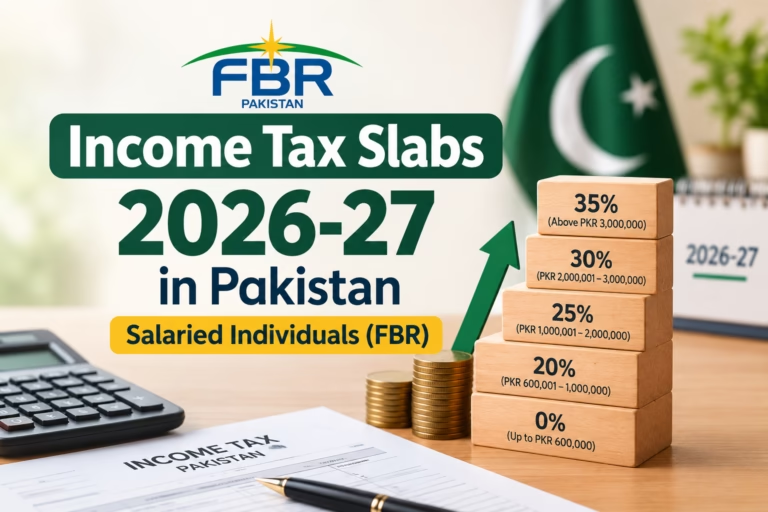
Looking for the current rates? See the new Income Tax Slabs 2026-27
The Federal Board of Revenue (FBR) has introduced revised income tax slabs 2025-26 aimed at relieving the financial strain on low and middle-income workers. Understanding these new tax rates is crucial for your financial health, as they can affect your earnings and budgeting strategies.
This article will provide you with a comprehensive guide to the updated income tax slabs and explain how these changes could benefit your financial standing, particularly if you fall within the lower or middle-income brackets.
What Are Income Tax Slabs?
Income tax slabs serve as a structured approach to taxation, designed to ensure that individuals contribute to public funds in proportion to their earnings. For salaried persons, the Federal Board of Revenue (FBR) defines a salaried individual as someone whose income from salary constitutes more than 75% of their total taxable income.
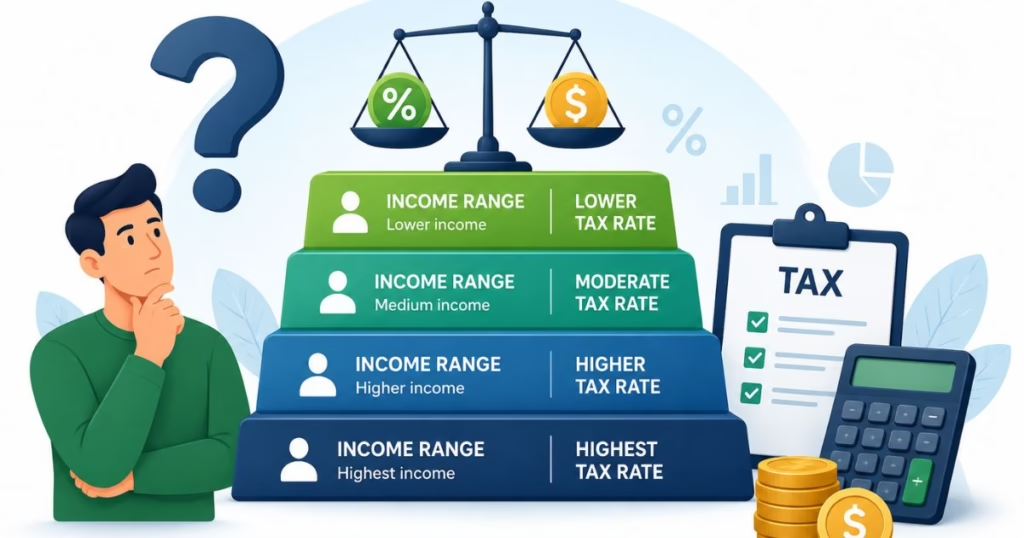
Understanding how these slabs function is essential for effective financial planning. The progressive tax system means that as your income moves up the tax brackets, only the income within those higher brackets is taxed at increased rates.
This classification is crucial because it opens the door to lower tax rates, allowing these workers to retain a larger portion of their earnings compared to non-salaried or business income earners.
Overview of the 2025 – 2026 Income Tax Relief
The 2025-2026 Income Tax Relief package marks a pivotal shift in Pakistan’s fiscal landscape, particularly aimed at alleviating the financial pressure on salaried individuals. With significant cuts for low-income earners, taxpayers within the Rs. 600,000 to Rs. 1.2 million range can expect relief as high as 80%.
While higher earners above Rs. 4.1 million receive a modest 3% relief, the overall tax structure reflects a targeted approach designed to redistribute wealth and promote equity. By coupling these tax adjustments with a 10% pay raise and a 7% pension increment for government employees, the administration is fostering a more prosperous economic environment.
Achieving a projected tax collection target of Rs. 14.131 trillion for FY26 requires innovative policies, and this income relief initiative stands as a testament to the government’s commitment to ensuring fiscal stability while supporting the backbone of its workforce.
Read More: Salary Tax Calculator.
FBR Income Tax Slabs 2025-26 for Salaried Persons – Official Rates
| Monthly Salary | Annual Salary | Total Tax 2025 | Total Tax 2026 | Monthly Tax 2025 | Monthly Tax 2026 | Decrease |
|---|---|---|---|---|---|---|
| 50,000 | 600,000 | – | – | – | – | – |
| 100,000 | 1,200,000 | 30,000 | 6,000 | 2,500 | 500 | (2,000) |
| 150,000 | 1,800,000 | 120,000 | 72,000 | 10,000 | 6,000 | (4,000) |
| 200,000 | 2,400,000 | 230,000 | 162,000 | 19,167 | 13,500 | (5,667) |
| 250,000 | 3,000,000 | 380,000 | 300,000 | 31,667 | 25,000 | (6,667) |
| 300,000 | 3,600,000 | 550,000 | 466,000 | 45,833 | 38,833 | (7,000) |
| 350,000 | 4,200,000 | 735,000 | 651,000 | 61,250 | 54,250 | (7,000) |
| 400,000 | 4,800,000 | 945,000 | 861,000 | 78,750 | 71,750 | (7,000) |
| 450,000 | 5,400,000 | 1,155,000 | 1,071,000 | 96,250 | 89,250 | (7,000) |
| 500,000 | 6,000,000 | 1,365,000 | 1,281,000 | 113,750 | 106,750 | (7,000) |
How to Calculate Income Tax on Salary in Pakistan 2025 – Step by Step
Step 1: Calculate Your Annual Gross Salary
This includes not just your basic salary but also any bonuses, commissions, and additional allowances such as house rent and utilities. It’s crucial to include all your income sources from July 1, 2025, to June 30, 2026, to get an accurate figure.
Step 2: Subtract Allowable Exemptions
The next step requires you to subtract allowable exemptions from your gross salary. Items like Zakat contributions, medical allowances, and pension contributions may be exempt up to 10% of your basic salary, which can significantly lower your taxable income.
Step 3: Identify Your Net Taxable Income and Applicable Tax Slab
With your net taxable income in hand, consult the Federal Board of Revenue (FBR) tax slabs for 2025. Understanding these brackets is crucial; not all your income is taxed at the same rate.
Step 4: Apply Tax Rates
Once you’ve pinpointed your slab, it’s time to calculate the tax. Add the fixed tax amount associated with your slab and apply the relevant percentage on any income exceeding that threshold, ensuring you don’t miss out on potential savings.
Step 5: Monthly Breakdown
To manage your finances better, divide your total annual tax liability by 12. This division will give you your monthly withholding deduction, allowing you to plan your budget effectively.
Real Salary Tax Calculation Examples – 2025-26
Monthly Salary: Rs. 60,000 | Annual Income: Rs. 720,000
Calculation: Rs. 0 (fully tax-free)
Annual Tax: Rs. 0
Monthly Deduction: Rs. 0
Monthly Salary: Rs. 120,000 | Annual Income: Rs. 1,440,000
Calculation: 2% × (1,440,000 − 600,000) = 2% × 840,000
Annual Tax: Rs. 16,800
Monthly Deduction: Rs. 1,400
Monthly Salary: Rs. 180,000 | Annual Income: Rs. 2,160,000
Calculation: Rs. 16,800 + 12% × (2,160,000 − 1,200,000) = Rs. 16,800 + Rs. 115,200
Annual Tax: Rs. 132,000
Monthly Deduction: Rs. 11,000
Monthly Salary: Rs. 240,000 | Annual Income: Rs. 2,880,000
Calculation: Rs. 132,000 + 26% × (2,880,000 − 2,200,000) = Rs. 132,000 + Rs. 176,000
Annual Tax: Rs. 308,000
Monthly Deduction: Rs. 25,667
Income Tax Slabs Comparison: 2024-25 vs 2025-26 Pakistan
| Annual Taxable Income (PKR) | 2024-25 Tax Rates | 2025-26 Tax Rates |
|---|---|---|
| Up to 600,000 | 0% | 0% (Fully Exempt) |
| 600,001 – 1,200,000 | 5% of amount > 600K | 1% of amount > 600K |
| 1,200,001 – 2,200,000 | Rs. 30,000 + 15% > 1.2M | Rs. 6,000 + 11% > 1.2M |
| 2,200,001 – 3,200,000 | Rs. 180,000 + 25% > 2.2M | Rs. 116,000 + 23% > 2.2M |
| 3,200,001 – 4,100,000 | Rs. 430,000 + 30% > 3.2M | Rs. 346,000 + 30% > 3.2M |
| Above 4,100,000 | Rs. 700,000 + 35% > 4.1M | Rs. 616,000 + 35% > 4.1M |
Deductions That Can Reduce Your Taxable Income in 2026
Here’s a closer look at the potential benefits that can lighten your tax burden in 2026:
Voluntary Pension System (VPS)
Contributing up to 20% of your taxable income to approved pension funds not only builds your retirement savings but also provides a tax credit reflecting your average tax rate.
Zakat and Charitable Donations
Paying Zakat under the Zakat and Ushr Ordinance 1980 is a strategic way to lower your taxable income. Generous donations to approved non-profit organizations can further reduce your tax liability.
Home Loan Tax Credits and Life Insurance Premiums
If you’ve taken out a home loan, paying life insurance affords you tax relief.
Educational Incentives
Educators and researchers employed in non-profit sectors can take advantage of a 25% tax rebate. Approved provident fund contributions also add an extra layer of tax efficiency.
Medical Allowance
Up to 10% of your basic salary can be exempt if not separately reimbursed, providing a cushion for your healthcare expenses.
House Rent Allowance (HRA)
Individuals renting homes can breathe a little easier, as up to 45% of their basic salary can be declared.
Conveyance Allowance
With an exemption up to Rs. 50,000, this allowance can significantly bolster your budget for transportation costs. Read More: filer and non-filer in pakistan.
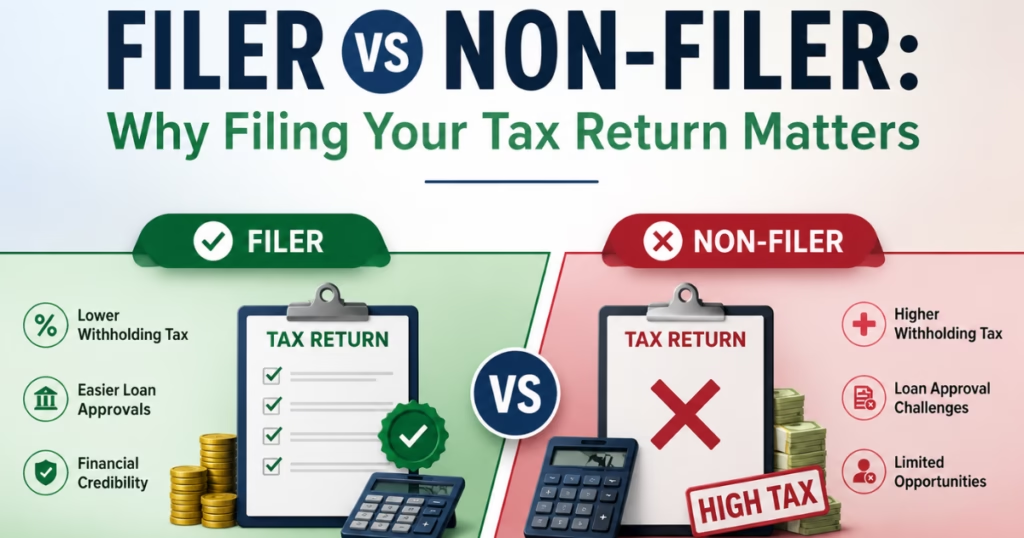
Filer vs Non-Filer: Why Filing Your Tax Return Matters
Understanding the distinction between filers and non-filers can dramatically impact your financial well-being. By becoming a filer, you unlock lower withholding tax rates that can significantly impact your finances.
Legal and Compliance Risks
Beyond the immediate financial implications, being a filer illustrates your commitment to compliance with the Federal Board of Revenue (FBR). This proactive stance protects you from unexpected legal repercussions and penalties like SIM or utility blockages.
Property purchases
Filers pay only 3% compared to the 4% charged to non-filers.
Cash withdrawals
Filers get advantage above Rs. 50,000, where filers are taxed at 0.6% instead of 1.2%.
Dividend income taxation
Non-filers see a steep 30% tax, filers enjoy a more reasonable 15%.
Vehicle registrations
vehicle registrations are subject to reduced rates for filers, making the total cost of vehicle ownership more manageable.
With such compelling reasons to file, the process is straightforward: simply submit your annual income tax return on the FBR Iris portal before September 30, 2026, ensuring your National Tax Number (NTN) is registered. Don’t overlook the long-term benefits of being part of the ATL; the savings can add up substantially.
Withholding Tax on Salary – How Your Employer Deducts It
Your employer acts as an intermediary, calculating your estimated annual tax based on the FBR’s current salary tax slab rates and deducting it monthly. This method ensures that you are only responsible for a fraction of your total tax burden at any time, as it aligns your payments with your earnings.
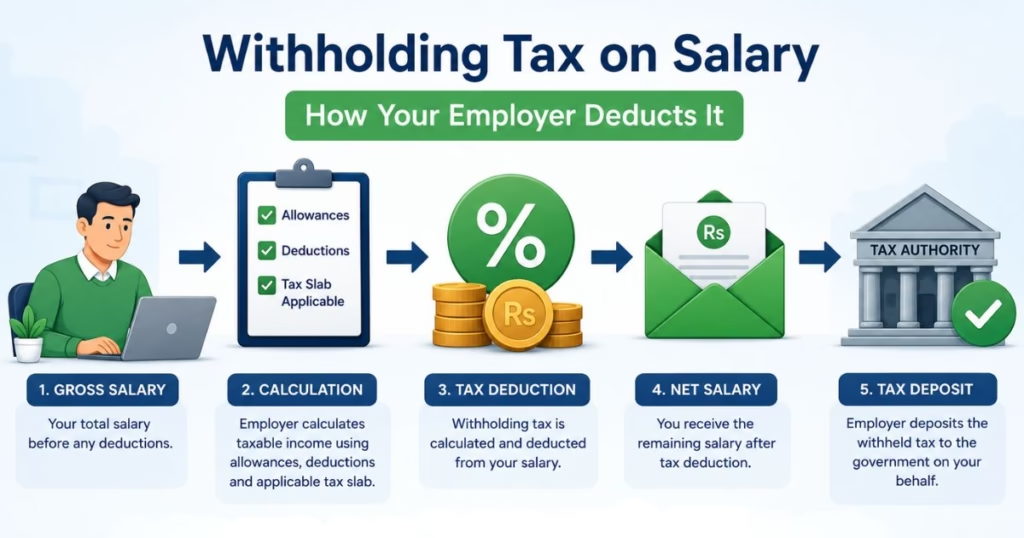
Your employer manages deductions, this doesn’t absolve you of the responsibility to file your annual income tax return. By doing so, you can not only verify your tax liability but also reclaim any excess tax withheld. Non-filers often face harsher penalties, which makes it even more essential to understand your tax implications.
Challenges and Criticisms
The burden of salary taxation in Pakistan is disproportionately heavy, particularly for the formal sector, where employees often find themselves under pressure to meet stringent tax obligations. Critics argue that the system unfairly targets salaried individuals, while sectors like agriculture enjoy minimal taxation.
High tax slabs can reach up to 45%, leading many to view such rates as confiscatory. With soaring inflation compounded by these taxes, the purchasing power of middle-class households is severely impacted.
The rigid focus on increasing tax filers, rather than broadening the tax base, leaves a gap where informal sectors thrive and contribute little to the economy. This scenario creates a paradox where those abiding by the law are penalized, while others escape scrutiny.
Income Tax Slabs Apply Uniformly Across All of Pakistan
The Federal Board of Revenue (FBR) sets these rates annually, ensuring that salaries are taxed consistently across cities like Karachi, Lahore, and Islamabad. This means that a professional in Lahore pays the same federal tax rate as one in Peshawar, promoting fairness and minimizing confusion.
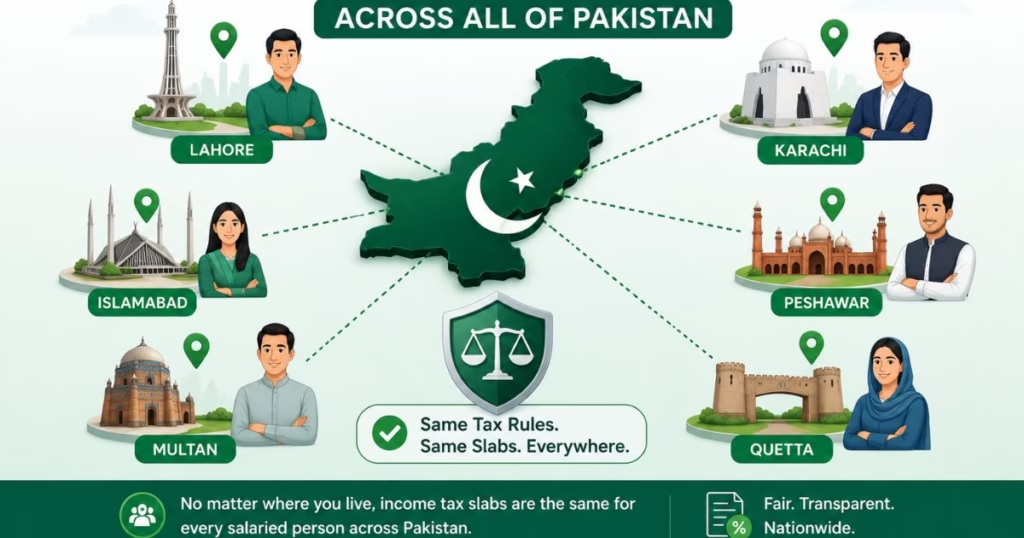
With a tax-free limit set at Rs. 600,000 for the fiscal year 2025-26, many individuals in lower income brackets benefit significantly. While some areas like Azad Kashmir and Gilgit-Baltistan operate under modified tax systems, the core principle remains uniform.
How to File Income Tax Return Online in Pakistan – Salaried Person Guide
With the FBR IRIS portal, you can streamline the process with just a few clicks. Here’s how to ensure a hassle-free experience:
Preparation is Key
Begin by gathering essential documents, including your CNIC, salary certificate, and tax deduction certificates. This will save time and reduce errors when filling out your return.
Log In and Select Form 114(I)
Navigate to the FBR IRIS portal, log in, and click on “Declaration” to choose Form 114(I). This form is specifically designed for salaried persons.
Ensure to regularly check your calculations against the system’s automatic tax liability breakdown. After verifying all information, don’t forget to submit and download your acknowledgment for your records and peace of mind. Filing by the September 30, 2026, deadline not only keeps you compliant but also ensures you avoid any late fees.
Conclusion
The 2025-26 income tax slabs for salaried individuals in Pakistan are designed to offer significant relief, especially for those in lower to middle-income brackets. With reduced tax rates, many taxpayers will experience an increase in their disposable income.
Its essential to actively engage in the tax filing process. Ensuring that you claim all eligible deductions, staying compliant by maintaining your filer status on the FBR Active Taxpayer List, and submitting your annual return by the September 30, 2026, deadline are critical steps.
FAQs
What Are The New Income Tax Slabs For Salaried Persons In Pakistan 2025-26?
For annual incomes up to Rs. 600,000, the tax rate remains at 0%, 1% for those earning between Rs. 600,001 and Rs. 1,200,000, earning between Rs. 1,200,001 and Rs. 2,200,000, the tax rate is 11% plus a fixed amount of Rs. 6,000. This trend continues with higher income brackets, with rates reaching up to 35% plus fixed amounts for those earning above Rs. 4,100,000.
What Is The Tax-Free Salary Limit In Pakistan 2025?
The tax-free income limit for salaried individuals is set at Rs. 600,000 annually, which translates to Rs. 50,000 per month. This means that if your yearly salary falls below this threshold, you will not be liable to pay any income tax.
How Much Tax Do I Pay On Rs. 100,000 Monthly Salary In Pakistan 2026?
If you earn a monthly salary of Rs. 100,000, your total annual income amounts to Rs. 1,200,000. According to the current tax brackets for the 2025-26 fiscal year, you would pay an annual tax of Rs. 6,000, which translates to just Rs. 500 per month.